Sunday, March 27, 2011

Amy's Bday dinner and Booze Cruise

Sushi Train

Audrey and Sadina

Kate, Kerry, Aimee, and Alex

Happy Birthday Amy!

my chicken wings! (don't like sushi...) 


ready for the booze cruise! (anything but clothes themed!)


Mike in his apron and Lisa in her wrapping paper

me in my trash bag, Danielle in her newspaper dress

Mickey in her candy wrappers and me in my trash bag


Lauren and I in our trash bags

Danielle, Tessa, Lisa, Mike, Lauren, and me

some randoms in cool costumes


me and Olivia in her Australian flag (she plays lax with me!)

Lisa and Lauren


Mike, Lisa, David, and someone...

me and Lauren

got the warrior helmet! 

Melbourne Zoo for Australian Wildlife Biology

Pelican

This pelican was posing for me

Australian fur seal

Australian freshwater crocodile 

Sunday, March 20, 2011

Kayaking with MUMC (Melbourne University Mountaineering Club)

Jamie and Sam before we set off (it was pretty cold at first)

The car park we're leaving from. We were kayaking (or paddling as they say in Australia) on the Yarra River. 


Sam and Jamie again


made it to the halfway point!

kayaks and gear (helmets, life jackets, paddles, and decks - the covers that go over the opening that you sit in) 

some of the group

me and Robert - he was one of the really good ones! 


map of the first leg of our journey - we started around E5 and went left towards about A6

The map of the second half of the day - started around K2 I think and traveled to about A6 

waiting for the others to make it to the halfway point

here they come! 


there's Jamie in the middle!

Richard - one of the leaders


Kayaking was lots of fun! Before we left we had to do a wet exit, which is when they flip you over in your kayak and you have to undo the deck (the cover that goes over the hole where you sit) by pulling on a tab that's on the front of it and coming out of the kayak underwater. Unfortunately, when I first did it, the tab was not out, so I was stuck under the water, unable to breathe, and freaking out. Luckily, we had people watching us to make sure we got out, so the guy came over and flipped me back over. I then got the tab out and had to redo the wet exit in order to make sure I could do it. I did it, phew, but I was terrified for the rest of the day of flipping over and getting stuck, which put a damper on things somewhat. 

Other than that, it was a lot of fun! The kayaks were way different than sea kayaks - they were a LOT smaller and responded much more quickly to the paddle strokes. We went down some small rapids, which was a lot of fun! Overall, it was a great experience and I'd recommend it! There were some great leaders too - they could do the rolls and stuff in their kayaks - so cool!

Saturday, March 19, 2011

Classes

So I have finished my 3rd week of classes here already! Can you believe it? I sure can't! They say time flies when you're abroad - it's the truth! I'm taking Australia Now, Australian Wildlife Biology, Blue Planet - Intro to Marine Environments, and Aboriginal Women and Coloniality.

You already heard some info about my intro to marine env'ts class. The other day, we learned why the Great Barrier Reef will be disappearing in the next 50-100 years. (So COME VISIT ME NOW! hint hint. Mom. Dad. Caroline.) The ocean holds the majority of the carbon in the world. Because of the increase of CO2 in the atmosphere, the carbon cycle, which combines water and carbon dioxide to produce a hydrogen proton and a carbonate ion, will cause the oceans to become more acidic. The addition of hydrogen protons is what causes the oceans to become more acidic. Now, the coral uses the carbonate ions in the ocean in order to produce calcium carbonate, which is what their structure is made of. However, the more protons there are in the ocean, the more protons will combine with carbonate and create the bicarbonate ion. This, in turn, leaves little carbonate ions left for the corals to use. So yeah, in a nutshell, that's why the coral reefs are endangered from us loverly human beings.

My other classes are really interesting too. My Australian Wildlife Biology class is taught by this lady who has really short hair except for one long braid down the side of it that sits on her shoulder. She is hilarious. I have that class at 9 am, but it's totally ok cause she has such interesting anecdotes and stories about the animals we learn about that she makes it a lot of fun. Like, she worked in Antarctica. And is obsessed with the platypus.

My Australia Now class is somewhat interesting. It's a guy lecturing us for 1.5 hours each week on how Australia has a very dull history. He said that himself. We're all like, great, thanks for giving us a heads up that it's going to be dull. Really makes me want to pay attention and be here. But we have interesting readings for our tutorials, called tutes, that I have on Thursday. Essentially it's just an hour of a smaller group with a tutor (teacher's assistant) who leads us in a discussion about the readings and what we talked about in class.

My Aboriginal Women and Coloniality class is really interesting. The Australians did not, and some still don't, treat the Aboriginals (also called Indigenous) people well at all. The first group of convicts and their captain and crew essentially showed up, saw the Aboriginals, didn't recognize any sort of hierarchy or leader to negotiate a treaty with, so ended up just taking any land that they wanted. And due to their cattle and sheep farms, many of the water holes and places that the Aboriginals went to each year and knew that they'd find water and found, have dried up, are gone, or the Aboriginals are prevented from going back there. Some Aboriginals are given land for compensation, but the land has no water on it, so is no good to them. I have a whole book of readings from my Australia Now and Aboriginal Women and Coloniality class that I'll bring home.

One girl in my Aboriginal class is an Aboriginal woman from west Australia. Her family and people "live in the bush," meaning that they live off the land and hunt and fish and fend for themselves. Her name is Abby and she's really cool to talk to. She got a scholarship to come to the University of Melbourne and is the first of her family to go to university and to finish high school. I was lucky enough to sit next to her during our tute the other day, and we got to talking about the history of Aboriginals and the stolen generation, since I had no idea what that was.

So the white Australians thought that the Aboriginals were going to die out. So they decided to "provide a pillow for them" for their race to die out in peace. However, the Aboriginals were not actually dying out. The Australian government decided to take the "half-caste" Aboriginal children - or the Aboriginals that looked more white than black, and put them in "missions." A mission is a place where there are nuns and they forcefully took the Aboriginal children to bring them up as white children, with white ideals and culture. So Abby's grandmother was one of these children that were kidnapped from their parents and put in a mission. This generation is known as the "Stolen Generation."

She said that her grandmother no longer knows how to speak her native language, so the rest of the family doesn't know how to speak it, because in the mission, they were only allowed to speak English. Abby said she took a video camera and taped her grandmother's story about the mission and what happened in her life, though she wouldn't talk much about what actually happened in the mission. In some missions, they abused the children.

Abby also said that there is not much education within the Aboriginal communities. They have a different sort of knowledge - the knowledge of the land, how to survive, how to find water, how to hunt and fish. But she said they need to bring education out to the Aboriginal people in order to educate them. A lot of the men are abusive to the women and the percentage of Aboriginals in jail compared to other races is much higher.

I'm reading a book titled "Coonardoo," by Katharine Susannah Prichard, which was published in 1929 and is about an Aborignal woman and a white man being in love. It was very controversial at the time. It's incredibly interesting, I'd recommend it. We also have to read "Talkin' Up to the White Woman," by Aileen Moreton-Robinson, which is also supposed to be good. And I was recommended the movies First Australians, Rabbit Proof Fence, Black Chicks Talking, and Bran Nue Dae (which Abby's uncle wrote as a screen play, toured around the country with, and someone bought the play off of him. I guess he's been in and out of mental institutions frequently though). All of those talk more about the Aboriginals, so I'm hoping to check them out sometime soon.

Tuesday, March 15, 2011

Blue Planet -Intro to Marine Environments Excursion

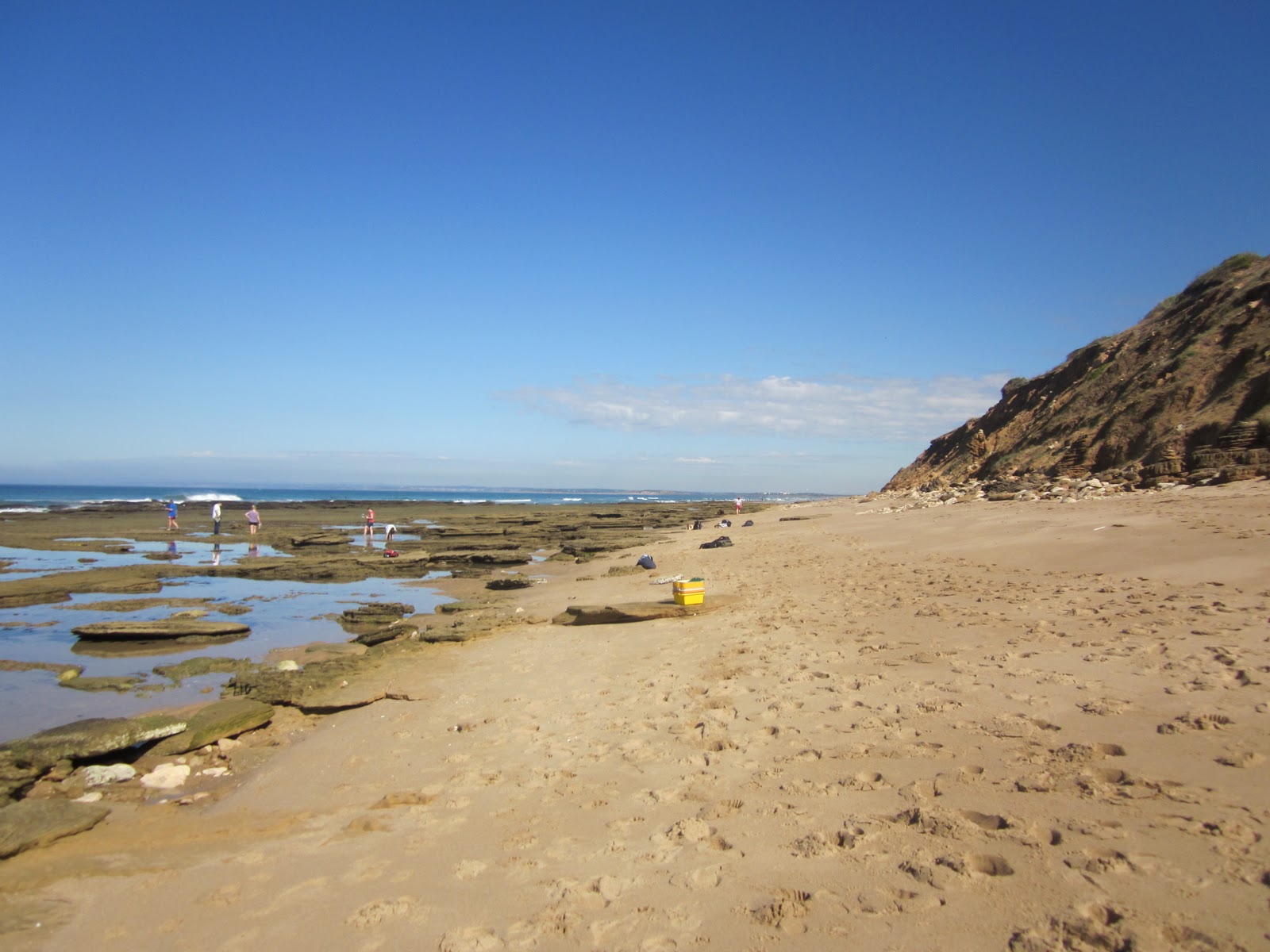
So this past weekend, my Intro to Marine Environments class had an excursion to the beach at Barwon heads, where we studied the intertidal zone at the rock platform there. This is the introduction we were given to our lab: 


At low tide, the rocky intertidal regions of coastlines are fascinating areas for the study of marine life. Exposed rocky shores are challenging places to live, with organisms pounded by surf and scoured by sand at high-water and exposed to high light levels and desiccation at low water. The physical forces placed upon algae and animals due to waves far exceed those in terrestrial and oceanic environments. Despite the maelstrom, rocky shores support diverse plant and animal communities that are adapted to grow and reproduce in this environment.
The rocky intertidal is kept clear of sand and mud by the continuous direct action of ocean waves. Wave shock and forces are therefore a continuous challenge for life in the intertidal. Adaptations by these animals to these conditions include hard external skeletons, and low, rounded body profiles that have least resistance to the forces of breaking waves. Animals without these features may seek protection in rock crevices or cracks. Many intertidal animals and all of the intertidal seaweed species are very firmly attached to the substrate. The flexible stipes of the seaweeds allows them to bend and absorb wave forces.
The pattern and vertical range of the tide define the rocky intertidal region. Exposure to both the air and submergence for extended periods twice per day establishes rigorous and well defined zones. Intertidal organisms have adapted to the absence of seawater at low tide. Desiccation becomes a problem at low tide for algae and animals located high up on the shoreline. Unattached animals may avoid desiccation by inhabiting tide pools as the tide recedes. Many animals with hard shells simply close up at low tide to avoid drying out.
Biological processes also influence the distribution of organisms in the intertidal. Most intertidal animals can be classified as one or a combination of the following feeding types: (1) predators, (2) scavengers, (3) algal grazers, and (4) suspension feeders. Competition for space is high and most organisms are only successful competitors within narrow ranges of physical and biological conditions. This can lead to the formation of definite zones characterised by particular groups of plants and animals arranged in a vertical sequence from the low tide mark.
This field trip will introduce you to the physical forces which drive plant and animal community compositions as well as the morphological adaptations and behavioural strategies that organisms have evolved to cope with life in the harsh rocky intertidal environment. (Denny MW (1987) Life in the maelstrom - the biomechanics of wave-swept rocky shores. Trends in Ecology & Evolution 2: 61-66.)

On Saturday, we split into our groups and proceeded to the rock platform. We were given sheets to help us identify the organisms that we would find on the rock platform. We were in groups of 2, and were randomly assigned points within a 50m by 10m area to put a quadrat down (about a 1 foot by 1 foot metal square) and then count what organisms - seaweed, snails, chitons, limpets, were within the quadrat and how many there were/what percentage of the quadrat they covered (if seaweed). We also deployed light and temperature loggers and dynamometers, which measure wave velocity (there's a picture of this below). 
On Sunday, we tested four different hypotheses. The hypotheses were as follows: 
-H1: Intertidal organisms are more susceptible to lift rather than drag forces. 
-Limpets: Attach the high-tech clamps to the limpets and pull the limpets vertically or at 45 degrees at a constant force of 10 kg on the 25 kg spring scales. Measure the time taken for limpets to dislodge. Do 3 limpets vertically, 3 limpets at 45 degrees. Replace the limpets after they have dislodged and provide some moisture. They should re-attach after a while. 
-Hormosira: Make a noose from the light fishing line provided. Try to noose the stipe of Hormosira with fishing line. Lift vertically (lift force) or horizontally (drag force). Pull with a slowly increasing force. Watch the spring scale and record the force required for the stipe to break or dislodge (record break or dislodge also). Do 5-10 plants vertically and horizontally. Use the smaller spring scales for this task. 
-Turbo: (Turbo are snails). Noose turbo with fishing line underneath the edge of the shell. Repeat the same procedure as for Hormosira. Use the smaller spring scales for this task. 

-H2: Exposure to different temperatures affects the force required to dislodge organisms. 
-Limpets: Find two limpets of similar size at roughly the same place on the rock platform. Fill a plastic bag with ice, then add sea water and seal. Fill another plastic bag with sea water of ambient temperature. The idea here is to change the temperature of limpets but not to get them wet. Apply the different bags to the different limpets for 5-10 minutes. Attach the clamps to the limpets, pull at a constant force of 10 kg. Record the time taken for limpets to dislodge. Do 3-5 chilled and 3-5 normal temperature limpets. 

-H3: Exposure to desiccation affects the force required to dislodge organisms. 
-Turbo: Collect 20 Turbo from the lower intertidal. Find a dry area of rock platform in the sun with a shallow pool nearby. Place 10 Turbo in the shallow pool, 10 on the dry rock platform. Place them so that they can re-attach. Leave for 1 hour so the turbo on the dry rock desiccate. Noose the turbo with fishing line underneath the edge of the shell and measure the lift force required to dislodge them. Put the turbo back where you found them (roughly) when finished. Use the smaller spring scales for this task. 

-H4: Organisms are oriented on the rock platform to minimize wave force exposure. 
Limpets are oval in shape. Determine if their orientation with respect to the oncoming wave direction is random or non-random. Estimate and record whether limpets are aligned so that they have the smallest amount of shell exposed to the oncoming waves (write 0), or if they are attached at a 45 degree or a 90 degree angle to the oncoming waves. Replicate 100 times. 


Weekend of March 12-13th

Traveled to the beach 1.5 hours away to do some experiments for Blue Planet - Intro to Marine Environments. 


We set out 50 meter tapes and randomly placed quadrats along it, looking at the different organisms in the quadrats in order to determine the biodiversity of the intertidal zone. 


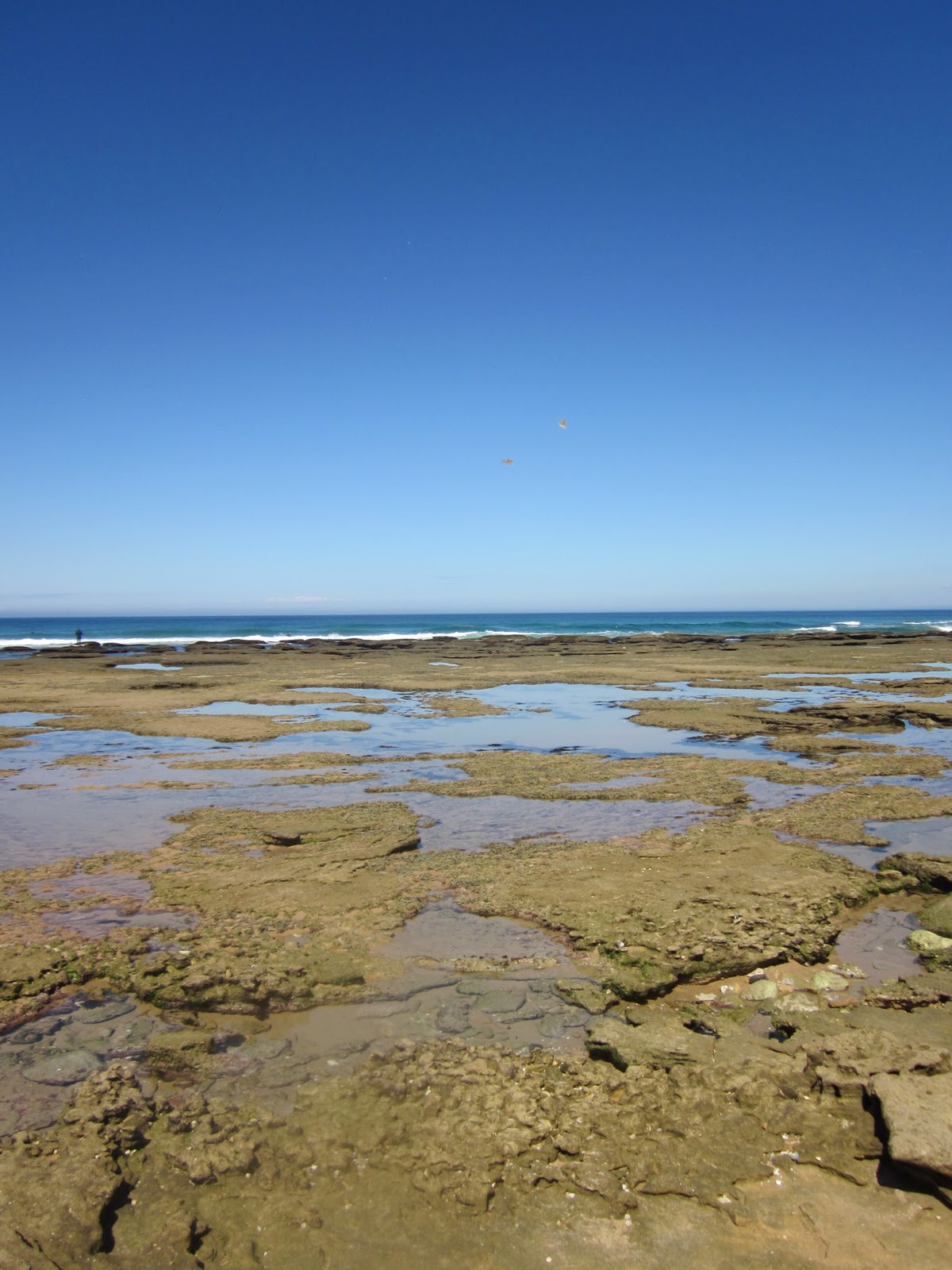
The rock platform that makes up the intertidal zone that we were working on. 


Rosie and Alex working on counting the organisms within a quadrat. 


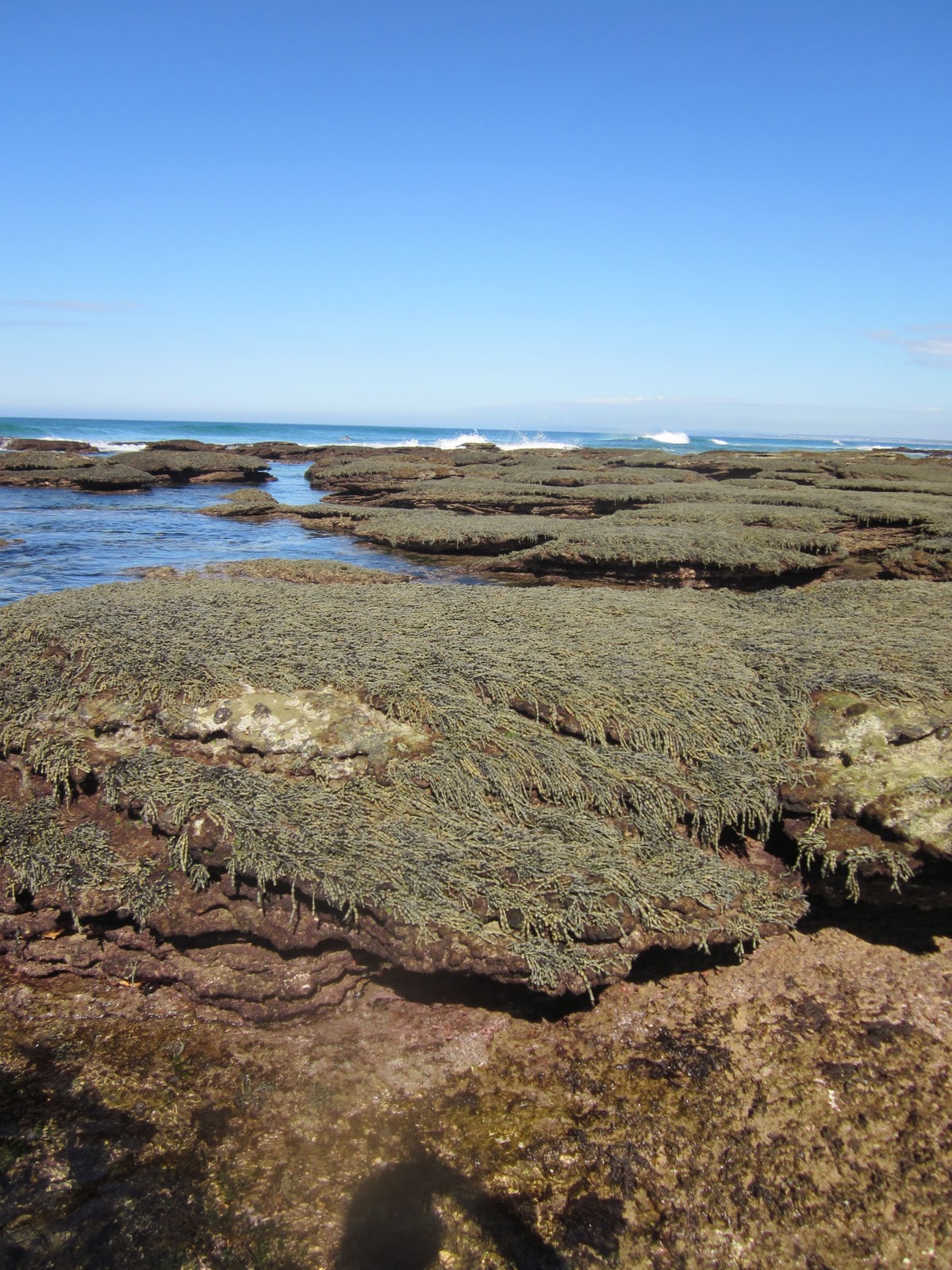
The most populous seaweed, Hormosira banksii. It's edible too! 


Some limpets and Hormosira


Using this cleverly devised ziptie, we can measure the wave velocity. The yellow cap is attached to a string that goes to the right end of the ziptie to a rubber band. The strength of the wave will stretch out the rubber band, pulling the ziptie locker thing along the plastic. We can then use that measurement to determine how strong the waves were. 


Rock pool


This is one single organism. It takes water in one end (one of the purple blobs) and spits it out the other end (the other purple blob). 


This orange clump on the underside of the rock is the same organism as above, just a TON of microscopic ones. The organism can either live in a colony, like this one, or be a single organism, like above. 


Sea anemones!


They're opening up as the tide is coming in - so neat!


The Moomba Festival


Flinder's station


The Moomba Festival! Funny story - I was told by an Australian that "moomba" is a derogatory term for white people that the Aboriginals have. They were saying it so often around the white people, that the white people assumed it was another name for the part of the country they were in. 


Crazy rides! The same as the ones in the US, except a LOT faster, more spins and turns and upside downs!


Fireworks!